|
 |
 |
|
 |
|
| |
UN/ISDR
International Environment
House II,
7-9 Chemin de Balexert, CH 1219 Chatelaine, Geneva 10, Switzerland
New phone and fax numbers:
Tel: +41 22 917 8908/8907
Fax: +41 22 917 8964
[email protected]
Postal Address:
UN/ISDR
Palais des Nations
CH-1211 Geneva 10, Switzerland |
|
| |
 |
| |

United Nations






|
|
 |
MEDIA ADVISORY
Global Assessment Report on Disaster Risk Reduction launch in
Bahrain, 17-18 May 2009
Date: 17 May 2009
Time: 13:00 (tbc)
Venue: The Ritz - Carlton Hotel in Manama, Bahrain
Speakers: Mr Ban Ki Moon, United Nations Secretary-General
English - Arabic |
|
|
|
IPCC to undertake a special report on risk reduction and management
The Intergovernmental Panel on Climate Change (IPCC) agreed at its 30th session in Antalya, Turkey, 21-23 April, to undertake the preparation of a special report entitled "Management of Extreme Events and Disasters to Advance Climate Change Adaptation", which was proposed by the UNISDR, on behalf of the ISDR partnership, and the Government of Norway. The IPCC special report will feature nine chapters including one dedicated to case studies and three to assessing risk management policies and practices at community, national and international levels. The draft outline of the report was developed at a scoping workshop hosted by Norway in Oslo and contained in the report of the workshop. The IPCC will produce the report in collaboration with the secretariat of the UNISDR, which will facilitate access to information from the disaster risk reduction community.
More information: [email protected] and/or www.ipcc.ch |
|
Conference on gender and disaster risk reduction in
Beijing, China from 20-22 April 2009
Women and men are affected differently by disaster due to the economic, social and cultural roles they play in society. 90 per cent of the people killed in the 1991 cyclone in Bangladesh were women. It was the same in USA, when hurricane Katrina hit New Orleans African American women were among the worst affected. Women are often the main victims of disasters as they account for more than 70 per cent of the world’s poor. more |
|
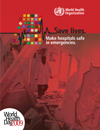 |
World Health day on the safety of health facilities
More than 11 000 medical institutions were damaged in China's Wenchuan earthquake in May 2008, forcing tens of thousands of people to seek treatment elsewhere. In line with the World disaster Reduction Campaign: "Hospitals safe from disasters" launched in 2007 together with WHO the UNISDR and the World Bank, WHO dedicates its World Health Day 2009 to "Make hospitals safe in emergencies".
|
|
During that day, 7 April, many events will be organized around the world, with the global launch taking place in Beijing, China, with the WHO Director-General Dr Margaret Chan in attendance. WHO advocates for safe facility design and construction and for the continuation of health care during emergencies. It also urges strengthening of emergency preparedness capacities to save lives and improve global health.
For more information about the WHO health Day, videos, PSA and activities please see: http://www.who.int/world-health-day/2009/en/ and http://www.youtube.com/who. and the joint UNISDR WHO and World Bank campaign ""Hospitals Safe From Disasters: Reduce Risk, Protect Health Facilities, Save Lives" consult: www.safehospitals.info
|
|
|
Disaster deaths and economic losses jump in 2008
2008 saw a marked increase in the number of deaths and economic losses compared to the 2000-2007 yearly average, according to the Center for Research on Epidemiology of Disasters (CRED) which released the new figures today in Geneva at a joint press conference with UNISDR.
2008 disasters in numbers
Press Release
|
|
|
New 2009 Terminology on Disaster Risk Reduction
An extensively upgraded and expanded terminology has been released by UNISDR. The new 2009 terminology replaces the longstanding and widely used 2004 terminology and is the result of a long process of ongoing review by the UNISDR and consultations with a broad range of experts and practitioners in various international venues, regional discussions and national settings. It aims to promote common understanding and common usage of disaster risk reduction concepts and to assist the disaster risk reduction efforts of authorities, practitioners and the public. Efforts are now underway by experts groups to produce versions in other UN languages. see more |
|
UN Sasakawa Award for Disaster Reduction - Call for nomination
Nominations close on March 18 for the Sasakawa Award for Disaster Reduction, which will be given in June 2009 in Geneva, Switzerland at the Global Platform for Disaster Reduction, and. The biennial prize has been worth US$50,000, and is awarded in recognition of significant achievements in DRR that have made real change at community and institutional levels. The award conditions have been revised so that applicants can be nominated by any ISDR System partner.
see more |
|
Call for contribution
The UNISDR Asia & Pacific is pleased to launch a call for contribution for its annual publication on disaster risk reduction “Disaster Reduction in Asia & Pacific – ISDR Informs: Issue 4, 2008” that will be issued in March 2009 to reflect the status of disaster risk reduction in 2008 in the Asia and Pacific region. Please note that special focus will be placed in this edition on achievements, innovative approaches, projects and activities focusing on Building Resilience to Tsunami. see more |
|
| Senior UN official appointed to new post on disaster risk reduction |
 |
17 November 2008 – Secretary-General Ban Ki-moon has appointed a highly experienced United Nations official to a new post created to step up action and international cooperation on disaster risk reduction.
Margareta Wahlström becomes Assistant Secretary-General for Disaster Risk Reduction and the Secretary-General’s Special Representative for the implementation of the Hyogo Framework for Action in the Secretariat for the International Strategy for Disaster Reduction (ISDR). |
The new post, which is voluntarily funded and based in Geneva, has been created to step up action and international cooperation on disaster risk reduction at a time when climate change is steadily increasing the number of extreme events across the globe. The impact of disasters is on a rise.
Ms. Wahlström, a Swedish national, has 25 years of domestic and international experience in disaster management and institution-building for strengthening capacity for disaster preparedness and risk reduction. Most recently she has served as Assistant Secretary-General for Humanitarian Affairs and the UN’s Deputy Emergency Relief Coordinator.
|
|
|
Report of the Secretary-General
Implementation of the International Strategy for
Disaster Reduction
The present report provides an overview of progress on the implementation of
the International Strategy for Disaster Reduction, in response to General Assembly
resolutions 62/192, 61/199 and 61/200. It also considers trends in disasters and
disaster risks, and the development of coordination, guidance and resourcing through
the International Strategy for Disaster Reduction system. more |
|
 |
Ban Ki-Moon
The Secretary-General of United Nations
Message on the International Day for Disaster Reduction
8 October 2008
The World Disaster Reduction Campaign for 2008-2009 focuses on making “Hospitals Safe from Disasters”. When health facilities are damaged, so, too, is our ability to improve maternal and child health and to provide other essential health services. But in resilient communities, health systems are better able to withstand natural hazards. We need to mobilize society at every level to reduce risk and protect health facilities so that they can save lives. more |
|
|
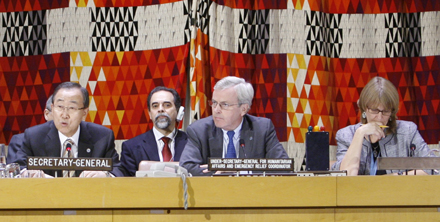 |
The Secretary-General called Members States to use disaster risk reduction for climate change adaptation
To help Member States find solutions to cope with climatic disasters, BAN Ki-moon, the United Nations Secretary-General, convened a ministerial meeting in New York on Monday 29th of September.
The Secretary-General called on ministers to lead the way at Poznan, Poland, in championing disaster risk reduction as a core element of climate change adaptation. He urged Governments to give high priority to implementing disaster risk reduction measures, in order to achieve the goals set by the Hyogo Framework for Action 2005-2015. see more |
|
The second session of the Global Platform for Disaster Risk Reduction Geneva, Switzerland, during the week of 15 - 19 June 2009.
The Global Platform for Disaster Risk Reduction is the main global forum on disaster risk reduction. At its first session in June 2007, it brought together representatives of governments, UN agencies, regional bodies, international financial institutions, civil society, the private sector and the scientific and academic communities to raise awareness on disaster risk, to share experience and to guide the ISDR system with a view to supporting countries to implement the Hyogo Framework for Action.
www.preventionweb.net/globalplatform |
|
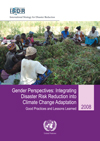 |
Gender Perspectives: Integrating Disaster Risk Reduction into
Climate Change Adaptation - 2008
Good Practices and Lessons Learned
This publication points out the vital nexus between women’s experiences of
natural resource management, climate change adaptation and disaster risk
reduction, and how they can come together to make whole communities
strong and sustainable. It also provides inspirational case studies of rassroots
women’s leadership, and of ways to support and encourage women’s full
participation as citizens in risk reduction, climate change adaptation,
development, and disaster preparedness. The case studies also point to
practical tools for implementing gender equality and mainstreaming gender
perspectives. |
|
|
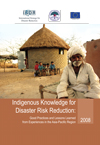 |
Indigenous Knowledge for Disaster Risk Reduction:
Good Practices and lessons Learned from Experiences in the Asia-Pacific Region 2008
Even before we came up with high technology based early warning systems, or standard operating procedures for response, numerous local communities worldwide have prepared, operated, acted, and responded to natural disasters using indigenous methods passed on from one generation to the next. The publication "Indigenous Knowledge for Disaster Risk Reduction: Good Practices and Lessons Learned from experiences in the Asia-pacific Region", produced with the assistance of the European Union, aims to build awareness for indigenous knowledge as an effective tool for reducing risk from natural disasters. By improving the understanding of indigenous knowledge and providing concrete examples of how it can be successfully used, this publication can help all practitioners and policy makers to consider the knowledge hold by local communities and act to integrate this wealth of knowledge into future disaster-related work. |
|
|
 |
Towards National Resilience -2008
Good practices of National Platforms for Disaster Risk Reduction”
Governments increasingly recognize the need for comprehensive multi-stakeholder and multi-sectoral national coordinating mechanisms – National Platforms for Disaster Risk Reduction - to reduce, prevent and manage the impact of natural hazards. 45 countries have already launched National Platforms for Disaster Risk Reduction. Several other countries are in a process of establishing them. In an effort to inspire and support the birth of new National Platforms, and also to strengthen existing ones, the UN/ISDR secretariat launches its new publication featuring nine National Platform case studies. |
|
|
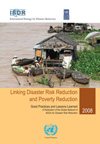 |
Linking Disaster Risk Reduction
and Poverty Reduction - 2008
Good Practices and Lessons Learned
A Publication of the Global Network of
NGOs for Disaster Risk Reduction
Building on last year’s effort, this publication seeks to highlight initiatives that have successfully linked poverty reduction and disaster risk reduction in various parts of the world. It features several projects and initiatives that show how DRR can be integrated into poverty reduction (or vice-versa) to help reduce the vulnerability of the poor and protect their livelihoods and development gains. |
|
 |
 |
|
| |
|