Facing Water Challenges in Swaziland: A WWDR3 Case Study
From WaterWiki.net
- Synopsis
Relying on transboundary rivers, Swaziland would benefit from continued cooperation with its neighbours as well as strengthened water resources management legislation at home. These would help alleviate the heavy burden of poverty and disease as well as the country’s reliance on external funding in the water sector.
Context | |
Focus Areas | IWRM, water supply and sanitation
|
Geographic Scope | |
Stakeholders | |
Contacts | |
|
Contents |
Background and Significance
The Experience: Challenges and Solutions
- Poverty and Infectious Diseases
Swaziland suffers from a heavy disease burden. The main causes of Swaziland’s high rate of infant mortality – diarrhoea, malnutrition and infectious diseases – can be linked to constraints on access to safe water supply and improved sanitation. Malaria remains a major health problem, especially in the Lowveld, the Lubombo plateau and parts of the Middleveld. The disease occurs mainly during or after the rainy season. It is estimated that 30% of the population resides in malaria risk areas and 38% in malaria receptive areas (Aquastat, 2005).
According to the Central Statistics Office (GOS, 2005), 69% of the country is affected by poverty. The incidence of poverty is much higher in rural areas (75%) than in urban settlements (49%). About 84% of the country’s poor people live in rural areas, where per capita income is one-fourth of the urban average, and people consume half as much food. About 66% of the population cannot meet basic food needs, and 43% live in chronic poverty (IFAD, 2008). Productivity at both household and national level is increasingly affected by the high rate of HIV and AIDS infection (Box 1.3). It is estimated that 26% of people aged 15 to 49 have the virus (UNAIDS, 2008), and that HIV and AIDS cause 47% of deaths among children under age 5 (WHO, 2006). Over 10% of households are headed by children who have lost both parents, and a significant number by very old grandparents who cannot do physical work (WSSD, 2002).
- Limited investment in water sector
The share of government spending allocated to the water sector has averaged less than 1% in recent years (Table 1.3). To improve water supply and sanitation coverage, the level of government funding needs to be raised. Meeting the national target of providing water and sanitation services to all rural people by 2022 would require a tenfold increase in investment. The majority of funds for the sector come from external sources. In fiscal 2003/2004, nearly two-thirds of estimated capital expenditure was in the form of international grants (Table 1.4). Current trends, however, show external donors in the water sector reducing their assistance to Swaziland. Thus, the government will need to allocate a greater share of the national budget for improving water and sanitation coverage, and increase the efficiency of investment.
- Improving regional cooperation
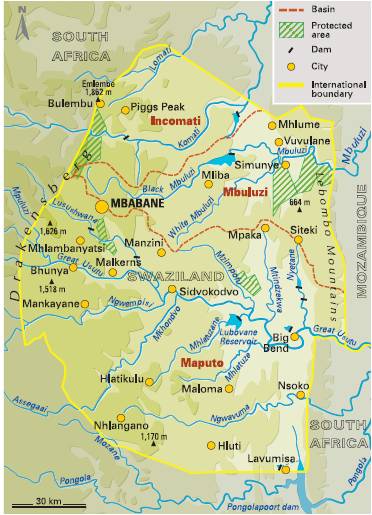
Although located in a generally arid part of southern Africa, Swaziland is considered well situated because it is traversed by several large rivers (the Komati, Mbuluzi, Great Usutu and Ingwavuma) flowing from or into South Africa and Mozambique. Given that 58% of overall water potential is derived from Swaziland and the rest originates in South Africa, upstream water resource development could reduce the water supply availability for Swaziland as well as downstream Mozambique.
In recognition of the importance of a coordinated
approach to the use and preservation of water resources, a
technical committee was formed under the SADC
framework to stimulate development and cooperation in
the region. The SADC member states, including Swaziland,
signed a Protocol on Shared Watercourse Systems in 1995,
which was reinforced in 2000 by a revised protocol seeking
to foster closer cooperation for sustainable management,
protection and use of shared watercourses.
In 1983, Mozambique, South Africa and Swaziland
established the Tripartite Permanent Technical Committee
to advise the three governments on water use and policyrelated
issues concerning the Incomati and Maputo rivers
(as the Komati and Great Usutu are known in
Mozambique). Swaziland signed treaties with South Africa
in March 1992 to establish a Joint Water Commission and
the bilateral Komati Basin Water Authority, which is
responsible for the design, construction and management
of the Driekkopies and Maguga dams. A treaty establishing
a Joint Water Commission between Swaziland and
Mozambique was signed in July 1999. Mozambique,
South Africa and Swaziland signed the Tripartite Interim
Agreement for Cooperation on the Protection and
Sustainable Utilisation of the Water Resources of the
Incomati and Maputo Watercourses in August 2002, and
are undertaking studies into the possible elaboration of a
comprehensive water sharing agreement for the two rivers.
The development, finalization and satisfactory
implementation of such agreements are important to
foster cooperation in the region and minimize waterrelated
conflicts that might arise as water needs increase.
Essentially, Swaziland is well endowed with freshwater resources.
As more than 40% of the water potential originates in
South Africa, and the water requirements of downstream
Mozambique need to be considered, functional
cooperation agreements on the use of transboundary
waters are vital to the sustainable socio-economic
development of Swaziland and its neighbours. Swaziland needs to strengthen its own legislation to improve the
management of water resources, as well as raise the level of
investment in the water sector, in order to alleviate the
excruciating poverty and heavy disease burden that its
people suffer.
Results and Impact
Lessons for Replication
Testimonies and Stakeholder Perceptions
References
See also
Aquastat. 2005. Swaziland. Rome, Food and Agriculture Organization. http://www.fao.org/nr/water/aquastat/countries/swaziland/index.stm (Accessed December 2008.) Central Statistical Office and Macro International Inc. 2007. Swaziland
Demographic and Health Survey 2006–2007: Preliminary Report. Calverton, Md., Macro International.
Global Fund to Fight AIDS, Tuberculosis and Malaria. 2008. Monthly Progress
Update – 31 January 2008.
http://www.theglobalfund.org/en/files/publications/basics/progress_upd
ate/progressupdate.pdf (Accessed January 2009.)
Government of Swaziland (GOS). 2002. Prioritised Action Programme on
Poverty Reduction. Mbabane, Ministry of Economic Planning and
Development,
Government of Swaziland (GOS). 2002. Swaziland’s National Report on the
World Summit on Sustainable Development 2002. Mbabane, Swaziland
Environmental Authority.
Government of Swaziland (GOS). 2004. Medium Term Expenditure
Framework, Budget 2005/05-2007/08. Mbabane, Ministry of Natural
Resources and Energy.
External Resources
The United Nations World Water Development Report 3


