Po
From WaterWiki.net
| The Po Basin is part of / comprises: · Europe & CIS · Western Europe · |
| Countries sharing the Po Basin: · Austria · France · Italy · Switzerland · |
| Facts & Figures | edit |
|---|---|
| Catchment AreaA | 87,100 km3 |
| Recipient | |
| Neighbouring BasinsA | Danube, Rhine, Rhone, Roia |
| PopulationA | 17,700,000 |
| Population DensityA | 20 /km2 |
| DischargeA | km3/yr |
| Surface Area | m3 |
| Average Depth | m |
| Water Volume | m2 |
| Water Stress | m3/person/year |
| Average Precipitation | mm/yr |
| Evaporation | mm/yr |
| Runoff | 23000 mm/yr |
| Land Use | |
| Irrigated Area | 23100 km2 |
| Irrigable Area | 89000 km2 |
| No. of DamsA | |
| Dam Density | dams/km2 |
| Total Water Withdrawals | km3 |
| For Agricultural Use | |
| For Domestic Use | |
| For Industrial Use | |
| Renewable Water Available (m3/yr/pers) | |
| References & Remarks | |
| A Transboundary Freshwater Spatial Database, Oregon University | |
> Articles | Projects & Case studies | Publications & Web resources | Who is who | Maps
- Latest 4 maps for / including Po (more..):
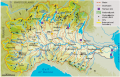 WWDR3Po.png |
News
Facts & Figures
- The Po River basin generates nearly 40% of the Italian national GDP through intensive industry and other economic activities.
- The Po River basin extends from the Alps in the west to the Adriatic Sea in the east and covers an area of 74,000 km2. While 5% of the basin lies in Switzerland and France, most of it is situated in northern Italy. This is where the basin is the largest, its main channel the longest (650 km), and its discharge the biggest.
- The Po basin is home to some 16 million people (2001), and extends over 24% of Italy’s territory. The regions of Piedmont, Aosta Valley, Liguria, Lombardy, Veneto, Emilia Romagna and Tuscany lie partially or completely within it, as does the Autonomous Province of Trento.
- Average precipitation varies from a maximum of 2,000 mm in the Alpine range to slightly less than 700 mm in the eastern plains, with an annual average of 1,100 mm.
- Meteorological records indicate that the total number of rainy days in Italy decreased by 14% from 1951 to 1996. The decrease was most pronounced in winter. The amount of rainfall also declined, especially in central and southern Italy. In addition, during the same period, persistent droughts grew more frequent. Similar trends have been observed in the Po River basin. Average annual rainfall has diminished there by 20% since 1975, and the average yearly discharge at Pontelagoscuro, near the lower end of the river, has fallen by between 20% and 25%.
- The amount of available freshwater resources in the Po River basin is estimated at 77.7 billion m3.
- Agriculture in the Po River basin is highly developed, accounting for more than half of the land use in the basin. In fact, at 30,000 km2 it is the largest cultivated area in Italy, and accounts for 36% of the country’s agricultural production. Accordingly, agriculture has the highest water demand of any sector in the basin, withdrawing nearly 17 billion m3 per year. About 11,000 km2 of the cultivated area is irrigated, almost exclusively (87%) from surface watercourses.
- The Po River basin is also urbanized, and home to 28% of Italy’s population. Lombardy, Piedmont and Emilia Romagna are the most populated regions and have a concentration of economic activities.
Water Basin Profile: Physical and Hydrological Characteristics
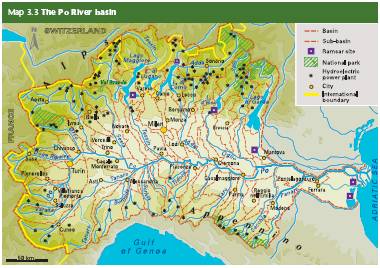
The Po River basin extends from the Alps in the west to the Adriatic Sea in the east (Map 3.3) and covers an area of 74,000 km2. While 5% of the basin lies in Switzerland and France, most of it is situated in northern Italy. This is where the basin is the largest, its main channel the longest (650 km), and its discharge the biggest.
The Po basin is home to some 16 million people (2001), and extends over 24% of Italy’s territory. The regions of Piedmont, Aosta Valley, Liguria, Lombardy, Veneto, Emilia Romagna and Tuscany lie partially or completely within it, as does the Autonomous Province of Trento. The climate is variable, ranging from Alpine in the mountainous north to cool temperate in the Apennines in the south. The flat central region is characterized by a continental climate. Average precipitation varies from a maximum of 2,000 mm in the Alpine range to slightly less than 700 mm in the eastern plains, with an annual average of 1,100 mm.
- Climate - Raining Less and Getting Warmer
Meteorological records indicate that the total number of rainy days in Italy decreased by 14% from 1951 to 1996. The decrease was most pronounced in winter. The amount of rainfall also declined, especially in central and southern Italy. In addition, during the same period, persistent droughts grew more frequent. Similar trends have been observed in the Po River basin. Average annual rainfall has diminished there by 20% since 1975, and the average yearly discharge at Pontelagoscuro, near the lower end of the river, has fallen by between 20% and 25%.
Analysis of data covering 130 years (1865–1996) reveals that declining rainfall was accompanied by increases in both minimum winter and maximum summer temperatures. In northern Italy, where the Po River basin lies, maximum temperatures increased by nearly 0.6°C and minimum temperatures by 0.4°C. The warming effect was 0.2 to 0.3°C higher in central and southern Italy.
The change in average temperatures has accelerated the melting of glaciers in the Alps. In 2005, at 2,500 metres of altitude, the spring snow-melt period started 15 days earlier than in 1990 (Caracciolo, 2007). The overall extent of glaciers in the range as a whole shrank by 49% between 1850 and 2000, from 4,474 km2 to 2,272 km2 (CGI, 2006), and glaciers in the northern Italian Alps decreased from 525 km2 in 1961 to 482 km2 in 1989, a decline of 8% (Biancotti and Motta, 2000). The increase in temperatures has also accelerated desertification, especially in central and southern Italy.
Water Basin Profile: Socio-Economic and Environmental Issues
- State of Water Resources and Use
The amount of available freshwater resources in the Po River basin is estimated at 77.7 billion m3. The basin is economically important for Italy, as 38% of the country’s GDP is generated there, thanks to extensive industrial activity complemented by farming, animal husbandry and tourism.
Agriculture in the Po River basin is highly developed, accounting for more than half of the land use in the basin. In fact, at 30,000 km2 it is the largest cultivated area in Italy, and accounts for 36% of the country’s agricultural production. Accordingly, agriculture has the highest water demand of any sector in the basin, withdrawing nearly 17 billion m3 per year. About 11,000 km2 of the cultivated area is irrigated, almost exclusively (87%) from surface watercourses. Irrigation networks are mainly composed of open channels, though pressurized systems are also used, chiefly for high value crops. Overland flow is commonly practised in almost half the irrigated areas. Rice, which has high water demand, is grown on over 20% of the irrigated land. Nationwide, about 40% of agricultural production and more than 60% of agricultural exports depend on irrigation (Bazzani et al., 2002, citing ANBI, 1992). The Po River basin is also urbanized, and home to 28% of Italy’s population. Lombardy, Piedmont and Emilia Romagna are the most populated regions and have a concentration of economic activities. Milan and Turin are the main urban and industrial agglomerations. The basin’s residents enjoy universal water supply and sanitation coverage. However, some 30% of the water in the drinking water network goes unaccounted for, and steps are being taken to minimize leakage from the water supply and sanitation infrastructure.
Meeting growing energy needs is one of the most important requirements for assuring sustainable socioeconomic development in the Po River basin. To harness the hydroelectric potential of the basin, 890 dams have been built. The Po basin accounted for 46% of national hydroelectric production in 2004, and 48% of total national electricity consumption as of 1994.
Water Basin Profile: Transboundary Political and Institutional Setting
Water Basin Profile: Emerging Challenges and Opportunities for the Future
Articles
- Recently updated articles on Po
- Po/articles (206 views) . . WikiBot
- Po/projects (240 views) . . WikiBot
- Po/publications (234 views) . . WikiBot
- Po/who is who (218 views) . . WikiBot
- Po/Maps (138 views) . . WikiBot
See the complete list of WaterWiki articles on Po
Projects and Case Studies
- Projects in or about Po
(this is a list of the 15 most recently updated entries. To see all projects click here)
No results
- Case studies in or about Po
(by popularity)
- Facing Water Challenges in the Po River Basin, Italy:A WWDR3 Case Study (3,068 views) . . WikiBot
See the complete list of WaterWiki documented projects in Po
Publications
- 5 most recently updated publications on Po
No results
- 5 most popular publications on Po
No results
See the complete list of WaterWiki documented publications on Po
Who is Who
- People working in Po
No results
See the complete list of Waterwiki users working in Po
- Organizations working in Po
No results
See the complete list of WaterWiki documented organizations in Po


